2026-10-10
Why PUMPWISE Horizontal Self-Priming Centrifugal Pumps Are the Ultimate Choice for Efficient Industrial Fluid Handling
1.Overview
2.Internationally renowned manufacturers of self-priming pump
3.Q1: How does a horizontal self-priming centrifugal pump work, and how does it achieve "foot-valve-free" self-priming?
4.Q2: How does a horizontal self-priming pump differ from a standard centrifugal pump?
5.Q3: In which industrial sectors and challenging conditions are horizontal self-priming pumps applied?
6.Q4: How should a horizontal self-priming pump be installed and maintained to maximize service life?
7.Conclusion
8.FAQ
Why PUMPWISE Horizontal Self-Priming Centrifugal Pumps Are the Ultimate Choice for Efficient Industrial Fluid Handling
In industrial fluid transfer and complex drainage systems, conventional centrifugal pumps often face severe challenges such as loss of prime during shutdown, frequent foot valve failures, and the operational headache of manual pre-filling. These issues frequently lead to high maintenance costs and costly unscheduled downtime.The PUMPWISE Horizontal Self-Priming Centrifugal Pump Unit overcomes these obstacles. Engineered with an advanced gas-liquid separation casing, superior suction capability, and industrial-grade corrosion/wear-resistant materials, it has become the premier choice across chemical processing, wastewater treatment, municipal drainage, and general industrial production lines.This article provides an in-depth analysis of the working principles, comparative selection criteria, and maintenance best practices for horizontal self-priming pumps—helping procurement managers and engineers make decisions that deliver a superior Return on Investment .
Internationally renowned manufacturers of self-priming pump
-Varisco:Renowned for its heavy-duty J-Series self-priming centrifugal pumps designed for abrasive liquids, construction dewatering, and flood control.
-Grundfos:A world-leading pump manufacturer offering highly energy-efficient and intelligent self-priming pumps for water treatment and industrial systems.
-Wilo :A top-tier German manufacturer providing durable, quiet, and high-efficiency self-priming centrifugal pumps for industrial processing and water supply.
-PUMPWISE : A professional industrial fluid solution provider specializing in high-efficiency, corrosion-resistant self-priming centrifugal pump units engineered for demanding chemical and industrial applications.
Q1: How does a horizontal self-priming centrifugal pump work, and how does it achieve "foot-valve-free" self-priming?
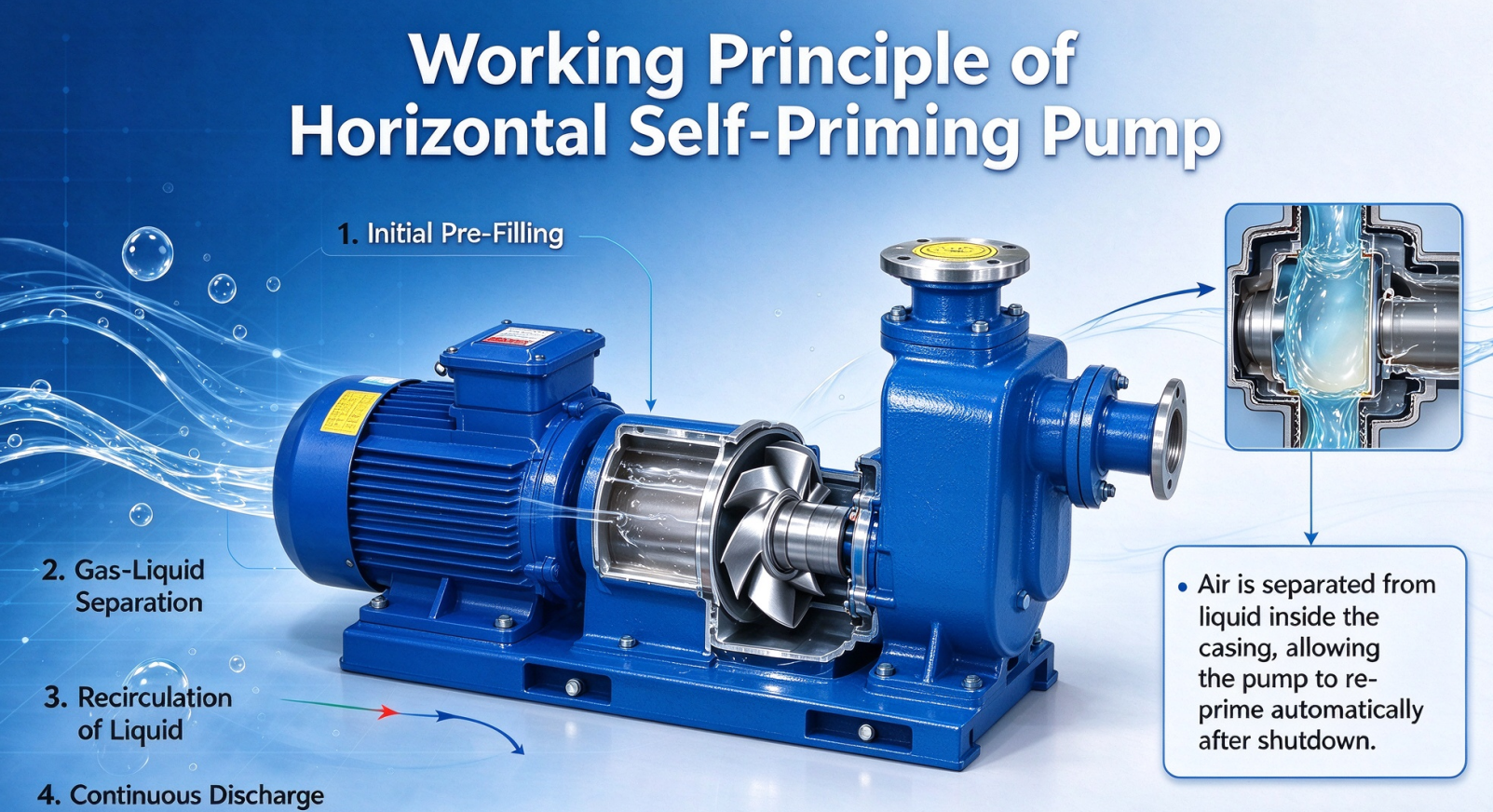
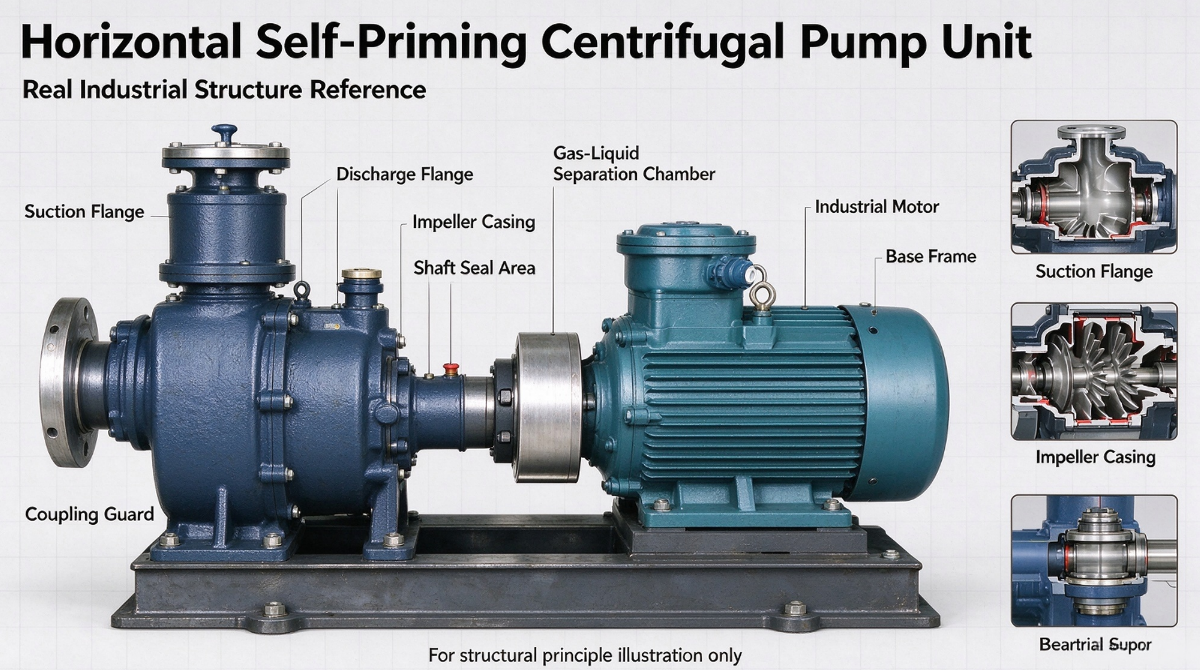
A: The key innovation of a horizontal self-priming pump lies in its integrated gas-liquid separation chamber and liquid storage reservoir built directly inside the casing. Its self-priming sequence operates through the following stages:
A: The key innovation of a horizontal self-priming pump lies in its integrated gas-liquid separation chamber and liquid storage reservoir built directly inside the casing. Its self-priming sequence operates through the following stages:
1.Initial Priming & Reservoir Retention: Before initial startup, liquid is poured into the pump casing once. The internal chamber permanently retains a sufficient volume of liquid for future operations.
2.Gas-Liquid Mixing & Separation: When the motor starts, the high-speed rotating impeller mixes the trapped liquid with air pulled from the suction line, driving the mixture into the separation chamber.
3.Air Evacuation & Vacuum Creation: Due to density differences, air escapes through the discharge port while the liquid settles back to recirculate through the impeller. As air is continuously evacuated, a strong negative pressure (vacuum) develops in the suction line, drawing liquid up into the pump casing to establish normal pumping.
4.Non-Return Check Valve: An integrated check valve at the suction inlet prevents backflow when the pump stops, ensuring immediate subsequent restarts without re-priming and enabling fully automated, hassle-free operation.