2026-03-27
Self-priming Pump Full-Scenario Application Guide
Q1: What are the core advantages of self-priming pumps, and why are they the first choice for both "lazy" and "expert" users?
Q2: What pain points do self-priming pumps solve in industrial production and chemical industries?
Q3: How do self-priming pumps perform in agricultural irrigation and municipal flood control?
Self-priming Pump Full-Scenario Application Guide
In the modern fluid transportation field, finding a pump that can handle complex environments without requiring cumbersome priming is key to improving production efficiency. Self-priming pumps, with their unique "vent first, then draw in water" capability, have become invaluable assistants in countless engineering projects, farmlands, and homes. No foot valve required, unaffected by air, one-time dosing, lifelong benefits.
Q1: What are the core advantages of self-priming pumps, and why are they the first choice for both "lazy" and "expert" users?
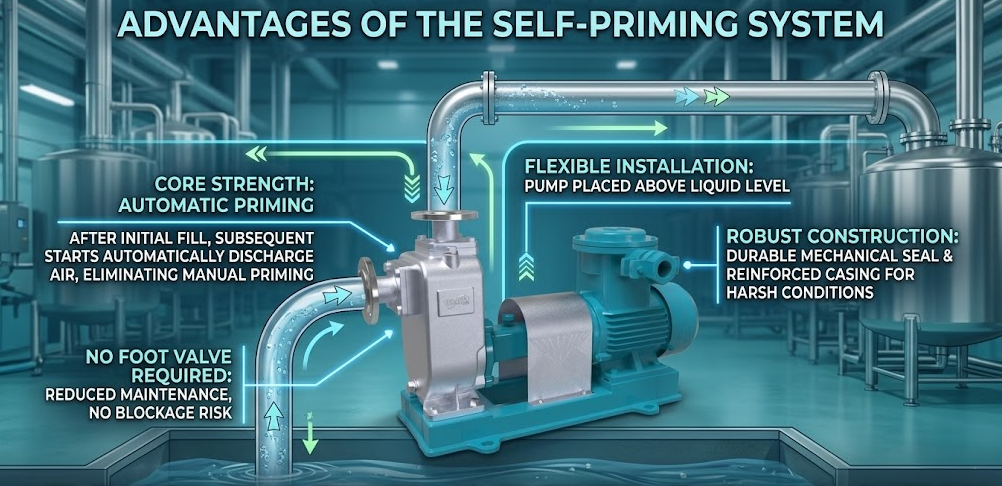
A: The greatest appeal of self-priming pumps lies in their powerful self-priming function and extremely simple operating logic. Unlike ordinary centrifugal pumps that require manual priming before each start-up, self-priming pumps, after initial installation and filling of the pump chamber, automatically expel air from the inlet pipe through their internal structure, achieving automatic water intake upon subsequent starts.
-Eliminating the hassle of a foot valve: Reduces maintenance hassles caused by foot valve blockage.
-Flexible installation: The pump body can be installed above the liquid level, not limited to submerged installation.
-Durable structure: Modern self-priming pumps mostly use mechanical seals and thickened pump bodies, greatly extending their service life in harsh environments.
A: The greatest appeal of self-priming pumps lies in their powerful self-priming function and extremely simple operating logic. Unlike ordinary centrifugal pumps that require manual priming before each start-up, self-priming pumps, after initial installation and filling of the pump chamber, automatically expel air from the inlet pipe through their internal structure, achieving automatic water intake upon subsequent starts.
-Eliminating the hassle of a foot valve: Reduces maintenance hassles caused by foot valve blockage.
-Flexible installation: The pump body can be installed above the liquid level, not limited to submerged installation.
-Durable structure: Modern self-priming pumps mostly use mechanical seals and thickened pump bodies, greatly extending their service life in harsh environments.
PWS Summary: Our patented flow channel design significantly improves gas-liquid separation efficiency. This means that, under the same conditions, our self-priming pump reduces the time from start-up to full-load water output by 30%, truly achieving "instant response" and eliminating waiting time in your production processes.
Q2: What pain points do self-priming pumps solve in industrial production and chemical industries?
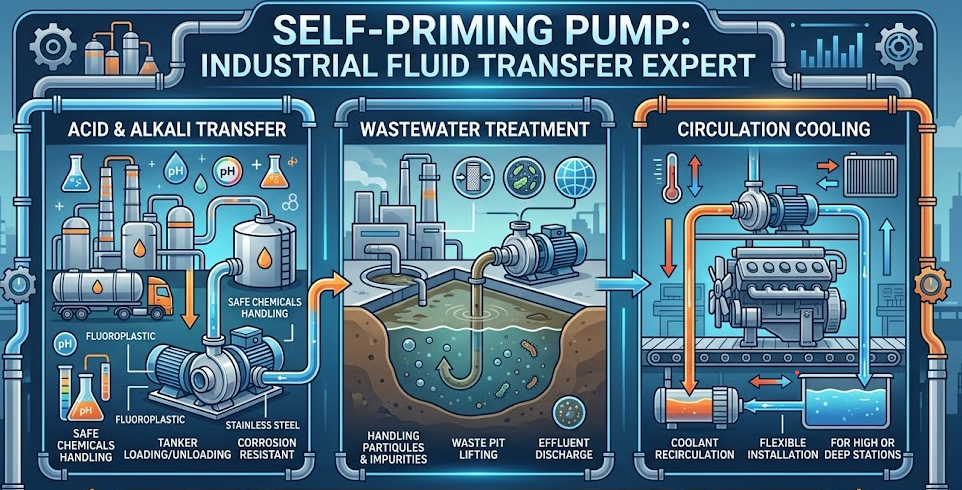
A: In industrial manufacturing, self-priming pumps primarily play the role of "fluid transfer experts." Because industrial pump pits often have a certain depth, and the liquids may be corrosive or contain air bubbles, the advantages of self-priming pumps are fully utilized:
-Acid and alkali transfer: When combined with corrosion-resistant materials (such as fluoroplastics or stainless steel), self-priming pumps can safely pump acid and alkali solutions or load and unload tank trucks.
-Wastewater treatment: Capable of treating water containing impurities such as fine particles, widely used for lifting and discharging wastewater from factory wastewater ponds.
-Circulating cooling: In workstations where it is inconvenient to install submersible pumps, self-priming pumps can achieve cooling circulation through pipeline extensions.
A: In industrial manufacturing, self-priming pumps primarily play the role of "fluid transfer experts." Because industrial pump pits often have a certain depth, and the liquids may be corrosive or contain air bubbles, the advantages of self-priming pumps are fully utilized:
-Acid and alkali transfer: When combined with corrosion-resistant materials (such as fluoroplastics or stainless steel), self-priming pumps can safely pump acid and alkali solutions or load and unload tank trucks.
-Wastewater treatment: Capable of treating water containing impurities such as fine particles, widely used for lifting and discharging wastewater from factory wastewater ponds.
-Circulating cooling: In workstations where it is inconvenient to install submersible pumps, self-priming pumps can achieve cooling circulation through pipeline extensions.
PWS points out that this not only avoids the seal failure caused by submersible pumps being submerged in corrosive liquids for extended periods, but more importantly, it greatly reduces subsequent maintenance costs and personnel safety risks. When the pump needs maintenance, operators do not need to enter dangerous deep pits; the work can be done on the ground, achieving "high safety and low cost" throughout its entire life cycle.
Q3: How do self-priming pumps perform in agricultural irrigation and municipal flood control?
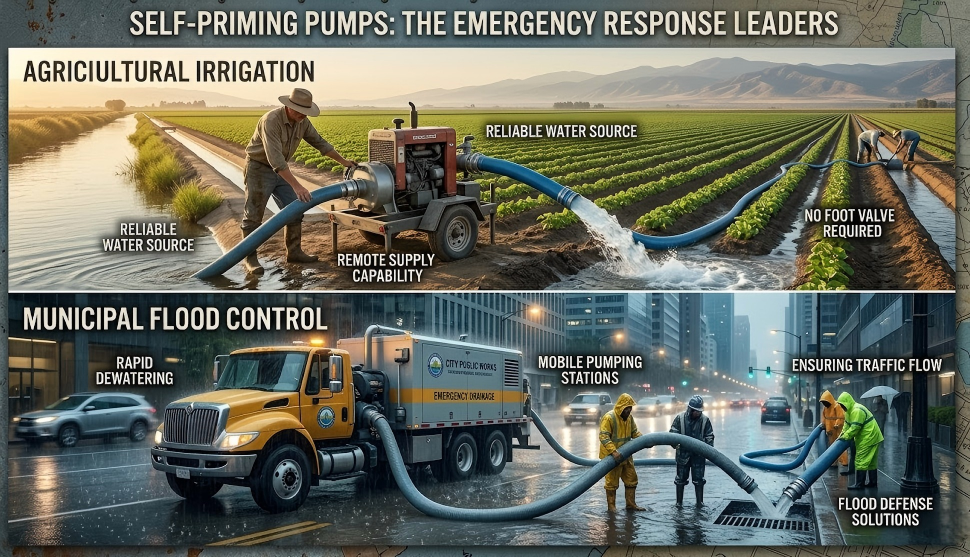
A: This is where self-priming pumps have the widest range of applications. Whether it's large-scale farmland irrigation or sudden urban flooding drainage, self-priming pumps are the standard for "emergency response":
-Farmland Irrigation: Farmers don't need to frequently go into the water to clean the bottom valve; they only need to start the motor to bring water from distant rivers or cisterns to the fields.
-Municipal Drainage: Mobile self-priming pump trucks are invaluable tools during flood control. When roads are severely flooded, there's no need to find low-lying areas; simply connect the pipeline for rapid drainage, ensuring urban traffic flow.
-Long-Distance Water Supply: The powerful combination of head and suction lift meets the needs of long-distance water source allocation.
A: This is where self-priming pumps have the widest range of applications. Whether it's large-scale farmland irrigation or sudden urban flooding drainage, self-priming pumps are the standard for "emergency response":
-Farmland Irrigation: Farmers don't need to frequently go into the water to clean the bottom valve; they only need to start the motor to bring water from distant rivers or cisterns to the fields.
-Municipal Drainage: Mobile self-priming pump trucks are invaluable tools during flood control. When roads are severely flooded, there's no need to find low-lying areas; simply connect the pipeline for rapid drainage, ensuring urban traffic flow.
-Long-Distance Water Supply: The powerful combination of head and suction lift meets the needs of long-distance water source allocation.
PWS believes that, especially in mobile emergency drainage scenarios, the self-priming pump's "insensitivity to air intake pipes" is its key to success. It allows for slight aging of pipelines or loose connections while still maintaining basic performance. This "tolerance" often means a higher survival rate and shorter rescue time in disaster relief.